Best AI Clothes Remover Apps for iPhone and Android: A Practical Guide
A practical mobile workflow covering real editor options, precise touch selections, original-file downloads and subscription checks.
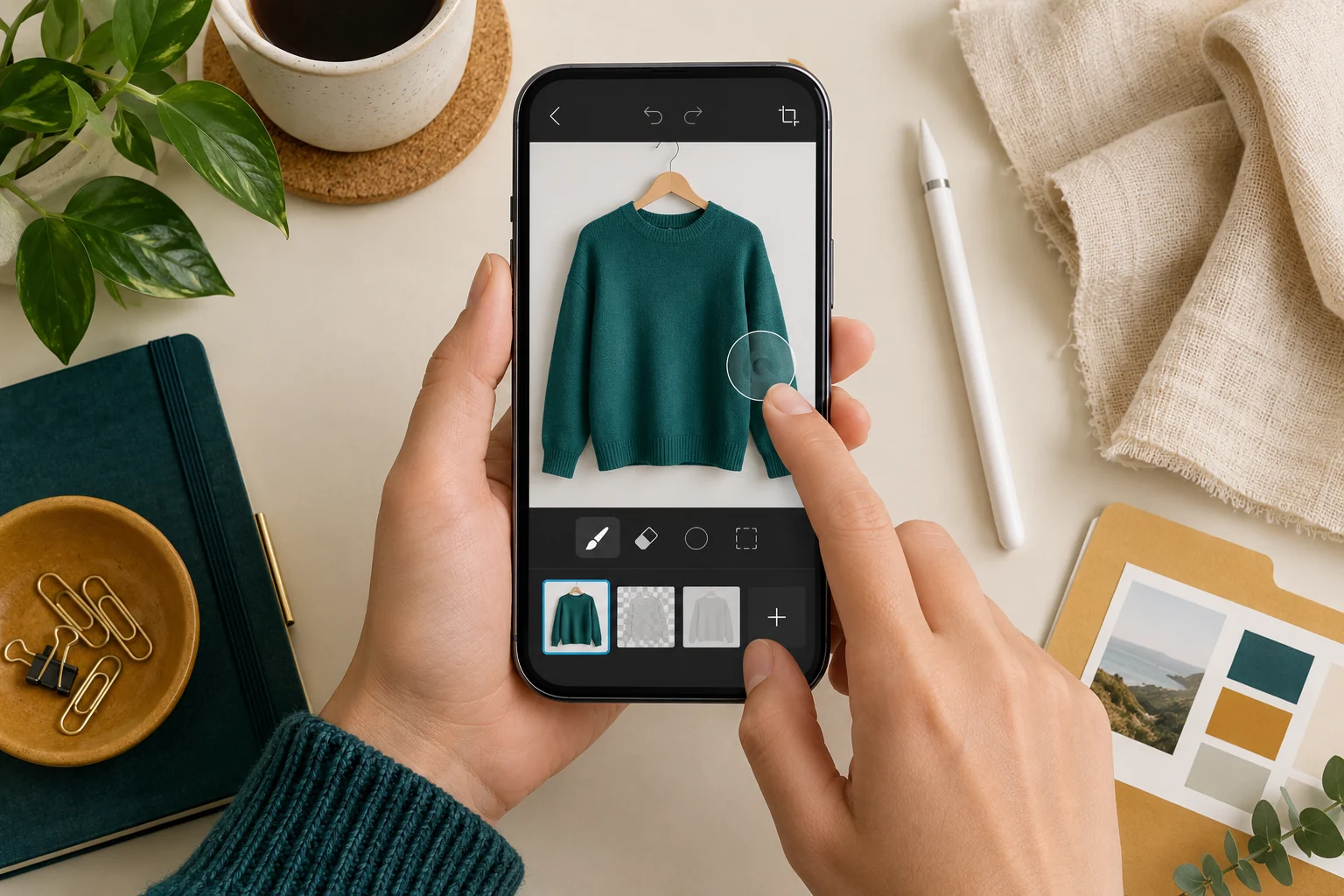
Quick answer: evaluate Photoshop on mobile, Firefly on mobile and Canva's photo editing workflow for the specific clothing job. Check the feature on your actual iPhone or Android device, make a precise garment selection and inspect an original-file export. A good mobile workflow also needs clear permissions, reliable saving and manageable billing.
The best AI clothes remover app for iPhone or Android is not necessarily the one with the most dramatic store screenshot. On a small screen, selection precision, file handling and revision controls strongly affect whether a clothing edit is usable.
This guide covers fully clothed fashion edits: recolouring a shirt, replacing an outfit and removing an outer jacket while preserving a covering base garment. It compares documented mobile workflows and provides a practical trial process. Feature availability can depend on device, account, region and plan, so verify the current app before purchasing.
1. Build a shortlist from documented capabilities
| Option | Documented starting point | Useful first test | Important check |
|---|---|---|---|
| Photoshop on mobile | Selections, Generative Fill and layer controls | Local replacement of a plain long-sleeve top | Platform-specific controls and downloaded file |
| Firefly on mobile | Generative Fill for selected image regions | Small, clearly defined garment replacement | Selection brush, variations and export route |
| Canva mobile photo editor | Photo editing within a design workflow | Clothing image used inside the final design | AI feature access and final design dimensions |
| Browser-based editor | Features of the particular web editor | Upload, selection and download on your phone | Touch usability, saving and memory limits |
This shortlist is based on official feature documentation. It supplies options for your own test, rather than an unexplained ranking. A tool's general photo editing capability does not guarantee that it can accurately reconstruct a hidden garment or reproduce a particular branded product.
2. Photoshop on mobile: inspect selections and layers
Adobe's iPhone and Android comparison lists Generative Fill, selection tools and layer properties on both platforms, with differences in other features. Check that table instead of assuming that every desktop control or every mobile instruction is identical.
For a clothing trial, choose a portrait with a clear garment boundary and hands away from the area to replace. Test whether you can refine the selection at useful zoom levels and keep unchanged portrait regions available. Those controls are important when a sleeve repair should not alter the face.
Adobe's mobile Generative Fill instructions describe selecting an area, entering a prompt and choosing a variation, with platform-specific navigation. Use those steps for the current app, then judge the final garment against the original source.
Try reopening the project and exporting the result before committing to a larger batch. Check whether the handoff suits your next step: another editor, a client review or a web upload. The ability to make an image is only part of the mobile workflow.
3. Firefly on mobile: test a focused generation workflow
Adobe documents Generative Fill on Firefly for iOS and Android, including selection and replacement of image regions. Evaluate it with a simple, fully covering garment request before attempting a complicated outfit.
Test whether the brush lets you add and subtract the intended clothing area without accidentally including hands or hair. A small touchscreen can make a broad selection easy and a precise boundary difficult. Zoom and revise the selection before spending more attempts on a weak mask.
Compare variations against the original at the same scale. If an output changes the person or invents unwanted accessories, reject it or repair those regions in an editor with the appropriate controls. More visually appealing clothing does not compensate for a portrait change outside the brief.
Check the export and further-editing route documented in the app. Save an actual file and inspect it outside the generation screen. Keep the source and the chosen candidate together so a later repair does not depend on finding an old preview.
4. Canva: evaluate the final design as well as the photo
Canva's photo editor help includes a mobile editing workflow. Its Magic Edit feature page describes generative image modification. Verify the relevant feature in your account and device before treating it as a requirement for the project.
This workflow is worth evaluating when the clothing image will end up inside a presentation, social post or other layout. Test the garment edit and the completed design export together, because the output canvas can change the resolution and crop that a viewer receives.
Keep text and decorative elements away from the part of the image you need to inspect. A busy layout can hide problems around a cuff or hem during review. Approve the photo itself before approving the entire design.
If exact product construction is required, bring a reference and use the same acceptance checks as on desktop. A mobile design tool can make a convenient presentation, but convenience does not establish the accuracy of an invented collar, logo or textile pattern.
5. Decide between a browser and an installed app
A browser tool can be convenient for occasional editing because you can open it directly. An installed app may offer a different file picker, touch interface or project workflow. Neither route is automatically more private, more accurate or cheaper.
Test the whole sequence on your own phone: select an original image, edit the garment, save the result, reopen it and send the correct file to the destination. If any step fails or produces only a screenshot, the workflow needs repair before it becomes a production method.
Check whether closing the tab or clearing browser data affects your work. Keep local copies of source files and approved exports. For a complex layered project, a desktop handoff may be more practical than forcing the entire job through a small display.
Use the general tools comparison to assess browser editors by actual controls. Then repeat the selection and export test on the phone, because desktop usability does not prove touch-screen usability.
6. Prepare phone photographs without losing useful detail
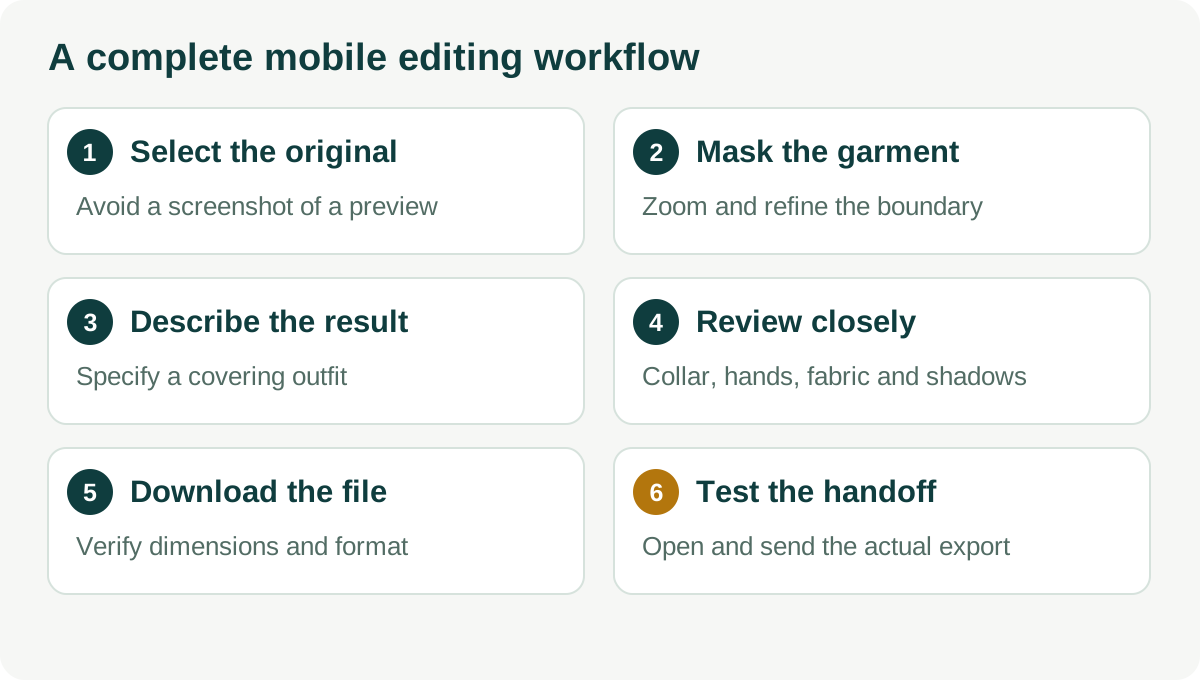
Choose the original camera image where possible. A screenshot of a photograph captures the displayed preview and can include less detail than the source. An image downloaded from a messaging conversation may also have been resized or recompressed.
Locate the real file before editing. If it is stored in a cloud library, make sure the editor can access the intended version. Keep a separate original and a working copy. Use project folders or consistent names so that several nearly identical exports do not become confusing.
Pick a clear source for the first attempt. Even lighting, visible garment boundaries and a simple pose make it easier to assess the app. Save more difficult cases, such as patterned sleeves or hands touching the collar, for the second part of the trial.
Do not crop too tightly before selecting the garment. The editor may need background and pose context to maintain the outline. Make the final crop after the clothing edit is approved, while retaining an uncropped master for future revisions.
7. Make a precise garment selection on a touchscreen
Zoom in until the clothing boundary is clear, then work in short strokes or small selection segments. Review the mask before generating. A finger can cover the area being selected, so move around the image deliberately instead of tracing the entire garment in one fast pass.
Protect the face, hair and hands where they should remain unchanged. A sleeve near a wrist may need a smaller brush or a separate repair. If the app does not offer enough control for the boundary, consider handing the image to a larger screen.
For an outer-layer edit, distinguish the area needing a covering base garment from the strip needing background repair. One broad selection can mix those tasks. A staged operation may be easier to review and undo.
Use an explicit prompt: “Replace only the selected jacket with a fully covering cream long-sleeve sweater; retain the original face, hands, trousers and room; match the source light.” This expresses the target, but the output still requires comparison with the original.
8. Review beyond the attractive phone preview
Inspect the neckline, cuffs, fingers, hem and fabric at a close view. Then zoom out to the final composition. Check that the replacement garment follows the pose and that shadows agree with the source scene. A small display can conceal both texture defects and identity changes.
Open the actual downloaded file in a separate viewer. Confirm that it is the full result rather than a preview or screenshot. Check dimensions, aspect ratio and transparency when required. The app's export button may offer several routes with different file properties.
For commercial work, review the image on the screen and at the size relevant to the final destination. Compare the actual product reference. Do not use an edited try-on picture as proof of exact fit or an unseen garment detail.
Keep an approval note describing what changed and what the image is approved for. That record is useful when the same phone contains both internal concepts and files ready for public use.
9. Check upload permissions, privacy and billing
Read the editor's processing and retention policy. A native app can still send images to a server, and a browser tool can have several different processing routes. Check the behaviour of the feature you use instead of inferring it from the platform.
Grant only the photo access needed for the task where your operating system offers that choice. Review account sharing and project visibility. If the source contains a client, employee or private interior, agree on the processing service and publication before uploading.
For subscriptions, record the billing period, renewal date and trial terms. Apple's subscription cancellation instructions explain how to manage App Store purchases through the relevant Apple account. For Android purchases, Google's Play subscription guidance explicitly notes that uninstalling an app does not cancel its subscription.
Separate cancellation from data handling. Ending billing does not necessarily delete uploaded files or exported images stored elsewhere. Check the provider's deletion process, and archive the files you legitimately need before losing access to a project.
10. Run a short trial before paying for a batch
Test one easy image and two representative difficult images. Record attempts, editing time, repair needs and approved exports. Use the same brief and final requirements for each app. This gives you evidence about your workload rather than a generic impression of the interface.
If the app handles simple jobs but cannot preserve a specific pattern, keep it for the suitable tasks and use another workflow for that product. A mixed workflow can be more practical than choosing one app for every garment photograph.
Calculate cost per approved file using the free versus paid guide. Include time spent managing uploads and downloads. A mobile workflow that requires repeated file recovery may cost more than its subscription suggests.
Run a file-handoff test before a client deadline
Use one approved test image to practise the exact delivery route. Save it from the editor, locate it in the phone's file storage, open it in another viewer and upload it to the intended review system. Confirm that the recipient receives the expected dimensions and file type. A route that silently turns the image into a compressed chat attachment needs adjustment before the real batch is delivered.
Repeat the test with a filename that identifies the product and revision. Check whether the publishing system renames the file or changes its crop, and keep the original export for comparison. If the project needs an editable master, test that handoff too. Resolving these practical details during the trial is more useful than discovering a missing file or unusable export after the clothing edits have already been approved.
Frequently asked questions
Can I do a clothing edit entirely on a phone?
Many documented mobile tools support local image editing, but suitability depends on the source and required precision. Test selection, repair and export on your actual device before relying on it for client delivery.
Is a mobile browser always better than an app?
No. Compare touch controls, saving, file handling, current terms and billing. The route that reliably produces an approved deliverable is the useful choice for that project.
Can I use a screenshot as the final export?
Use the editor's actual file download when available. A screenshot captures a displayed preview and may reduce dimensions or add interface elements. Inspect the downloaded file before publishing it.
Does deleting an app stop payment?
Manage the subscription through the account and billing service that made the purchase. Follow the relevant Apple, Google Play or provider instructions, and retain the cancellation confirmation.